11.11.2016

Church, Please!


Dear Bride of Christ,

I love you with a relentless passion that I can't abandon no matter how ugly or derisive you become. You are the creation and beloved of my Beloved, and so I am inseparably part of you. So, since I can't leave (which is what I'm best trained in doing), I need to have a literal "Come to Jesus" chat with you.

You - we - have forgotten our First Love. This week's fallout hasn't just been about the election and two incredibly flawed candidates and grotesquely mutated systems. Yes, that is what evoked the vitriol - one side crying out, "You don't care about the unborn!" and the other retaliating with, "You don't care about the marginalized!" - but the division and contempt has long been there.

Thankfully, we serve a God who doesn't accept Band-Aid and make-nice solutions; sadly, our simmering turned to boiling with these catalysts and led us to a civil war for all the world to see.

So we are sitting in the aftermath, our fractures exposed and on display. And we have a choice: Will we continue on gloating without taking the time to understand, and condemning without taking the time to weigh our words for the Spirit's grace-filled wisdom?

Because that hasn't worked thus far. And that isn't our Savior's agenda. Our Savior came to unify through His transformational love diverse and disparate groups so He  can use us all to restore His creation, not to come up with the best comment zinger on a blog we disagree with. In fact, He probably would not spend much time at all reading blogs (including this one).

I have had two trees in my yard die. They had dead branches for a while, and then the whole tree gave up the ghost. That is too vivid a truth for me to ignore. A little bit of disease or neglect must never be avoided or hidden.

Galatians 5:7-10 tells us what happens to those who get in the way of the Gospel message of freedom and love through Christ alone. If we're part of the division, we won't be spared the penalty. 

So let's take a radical step to save our tree with its dying branches. Instead of debating the theology of what I'm saying here or calling out other siblings by the Savior in an unloving, uncompassionate way that is not at all our Redeemer's style, let's all commit to pray for those with whom we disagree before we say anything. Then reach out to those we may not understand and ask gracious questions if we must converse. Nonetheless, let's always focus on God's love, with learning and unity as the outcome - and that doesn't mean making them learn our side and be united to it.

Bride, we have a black eye we gave ourselves. So let's put healing back as a priority so we can resume the work of the One who called us, who has been waiting for us to return to His open arms - together. He has a lot of other stuff for us to do, and I promise it involves very little blog commenting.

By His grace & in His time,
--j

P.S. Please listen to this song. We need to sing it together every day.


11.06.2016

Excavating Accidentally Buried Talents

"All meat, no parsley."
I've never been labeled a carnivore, but I love that phrase. It describes my thinking, and why I don't like reading most blogs - or writing them very often.

The metaphor was uttered at Prism :: Gifts, an event I attended yesterday for women wanting to discover their spiritual gifts and how to use them. It was glorious in the way spending a day with open-hearted sisters who want to be real and effective is glorious. There were tears and dancing and cake pops, and writing this now makes it sound like a bizarro lovefest adorned with pink flowers. But being in it - participating in the prayers that spoke life and redirected lives, listening to women share how having their voices silenced has caused them now to speak truth all the louder - was no ladies' tea party.

I have long been an advocate for knowing and applying one's gifts, and my dad taught courses in it when he was a pastor. The problem is that not everyone has caught the vision cast by God via Paul in Romans 12, 1 Corinthians 12, and Ephesians 4. A lot of churches I've been in seem to have viewed spiritual gifts as an afterthought, a luxury to dabble in once all the volunteer spots are filled with whomever is available regardless of their holy wiring.

And that is likely why I fell into doing all kinds of ministries for which I was not suited. I wanted to obey the instructions in the Bible to serve, so I volunteered wherever I was able. It was good to give, yes, but what I didn't realize is that I was called to serve using the gifts He had given me. Plus, I had gotten pretty good at thinking I could do anything if I needed to (we codependents are adorably delusional like that), so I wasn't even sure what my gifts were.

I often tell people, "Don't serve where you aren't gifted. You're taking up the space where the person who has that gift should be, and you'll burn yourself out." But what if you think you are in your gifting? What if you don't realize what it's like to be squarely alive in your unique passion?

The direct answers to those questions for me have been:
1. Take a solid spiritual gifts assessment like this one,
2. Read about your results,
3. Talk to people who know about spiritual gifts for further clarification and equipping, and
4. Get involved in serving with your gift(s).

Which brings me to now. The past few years have involved me confronting the uncomfortable reality that I am a leader. I've used a lot of other gifts to get around it - I'm really good at administration, teaching, and encouraging - but I love to lead when God opens that door. My life resume is replete in every single area with examples of me taking the reigns or emerging from a crowd or going my own direction. Okay, usually just that last one. But then I would turn around and see that people had followed me.

Being a leader is not a popular gift, especially for women, and I was content to simply lead small and avoid the responsibility of more consequential matters.

But "content" is kinda like a swear word to the Spirit - at least, in this context. And my own spirit was growing restless with this arrangement. Those two sentences are probably more related than the period between them would lead you to believe.

What was left for me to do? I owned it. I owned that my Creator designed me to be a leader, to cast visions and unite people. I owned that the other gifts have influenced the type of leader I am, but that I need to step out from behind their protection and allow myself to be unpopular, criticized, and unable to meet the crazy expectations assigned to me. This is how I serve, and by enduring these things I get to be me, energized in my perfect fit. I get to act out Ephesians 2:10: For we are God’s handiwork, created in Christ Jesus to do good works, which God prepared in advance for us to do.

We closed the event with the Parable of the Talents in Matthew 25:14-30. During the reading, I realized I hadn't intentionally buried my talent; I had simply concealed the controversial parts of it and packaged the rest with other talents to make it more palatable. In doing so, though, I hadn't invested it as well as I could have.

I doubt I'm the only one. In fact, I know I'm not the only one. For starters, the Founder of Prism Women, Renee Ronika, is unapologetically open about her struggle to accept her gift as a prophet. Other women who attended previous events and were present as leaders at this one shared similar stories of discovering and claiming their gifts. The good news: Owning your spiritual gift will cause your life to make more sense. It may not get easier, but knowing this Spirit-infused part of you will provide a sort of bigger-picture mission statement that gives confidence and purpose to each step.

So the parsley is getting tossed, and my plate is now home to a giant rib-eye. Or a pile of lobster tales, which is infinitely more appetizing to me. I don't even know if a giant rib-eye is a thing.

But the parsley is definitely gone.

10.17.2016

My Ambivalent Fallout with a Bush: A Story of Unexpected Restoration

Last December, we had our front and back yards turned into desert landscaping. They went from being full of dirt, weeds, a big mulberry tree that pigeons pooped from, and a thorny bougainvillea, to being full of rocks, desert plants, a smaller tree that pigeons disdain, and a wispy bush with orange flowers.

We were enamored.

And then the weeds started. They got out of control. We tried to fight them, but we had to have professionals come in.

We were disappointed.

The weeds grew, and our citrus tree in back died.

We were dismayed.

The weeds grew, our citrus tree in back died, and the plants in front began to die.

We were disgruntled.

And then the beautiful soft bush that had replaced our sinister bougainvillea started to wilt.


I was disheartened.

Attempts to reach the landscaper who planted the bush yielded little result, and our gentle green plant with the orange flowers succumbed to little black dots we learned were called aphids - or the more visceral term "plant lice".


Every day, I could barely stand to look outside at the yellowed, broken carcass. I felt sickened by the sight of it. Since I wasn't comfortable with this sensation, I repackaged it into feeling livid. I felt abandoned, and that bush was evidence of it.

It's embarrassing how long it took me to realize what I was projecting onto that bush. Yes, I was angry that I could not get help for our yard and for this lovely creation that had saved my children from pricked fingers while framing our house perfectly. But it was more than that. While this disintegration of our outside yard was occurring, my reality was being inverted inside our home.

I felt neglected by my own Creator.

But I knew I couldn't let that be the end of the story. He wired me to be too stubborn to let something called plant lice win this battle.

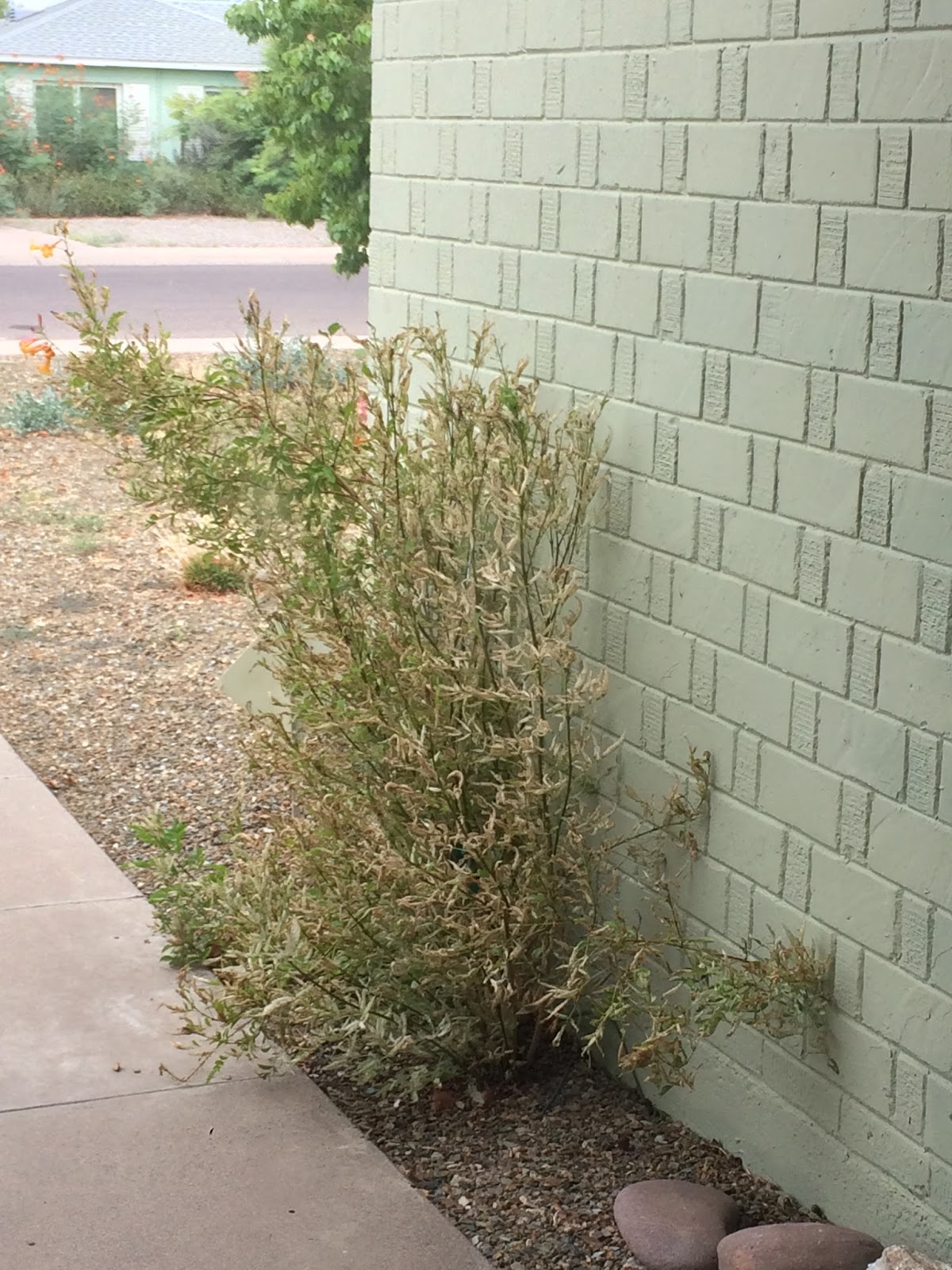
So I declared life over our little dead bush. In doing so, I prayed that my Creator would again turn His face toward me. I reached out to an advisor who assisted me in taking bold and measured steps to get the attention of the landscaper. It worked: he immediately got to work on attending to the neglect. Today, our bush showed these signs of life:


If you look closely, you can see bright green sprouting out of the brown and yellow. It's a true visual of this song.

It's also a reflection of how I'm feeling: I have my Creator's attention, and He is bringing new life out of my former self. At last He heard; at last He delivered me.

I sought the Lord, and He answered me and delivered me from all my fears. Those who look to Him are radiant, and their faces shall never be ashamed. This poor [wo]man cried, and the Lord heard [her] and saved [her] out of all [her] troubles.
Psalm 34:4-6 

In all this, I felt inexplicably compelled to read about how caterpillars become butterflies. We all know they crawl into a cocoon, hang out for a bit, then emerge in flight, right? I even shared one of my favorite quotes about this in a previous post.

Only it isn't true. Well, not for butterflies. For moths and other insects, yes.

But butterfly caterpillars actually harden their bodies into a chrysalis, and then their insides turn into goo. Goo! Here's where it gets even crazier: They have these things in that goo called imaginal discs that use the protein around them to grow into new shapes - legs, antennae, wings. In other words, they were carrying the precursors for their butterfly selves (Version 2.0, you could say) all along. Now that their old selves have been completely destroyed, their new selves can take shape into what they were meant to be all along!

Our Creator doesn't just have one set of 2D blueprints. His blueprints have many layers, and many dimensions. But His vision for us can only be realized when we go through those times of being dismantled, being broken, feeling neglected, crying out to Him. Every restoration story must have a before and a point of change so the after means anything.

I guess this might even require a new term. Because often the type of restoration He has in mind isn't the kind the bush experienced - returning to its previous state of flourishing - but instead into a new form like the caterpillar into the butterfly. So I'm going with a hybrid of restoration and transformation: Restormation.

Restormation is what my friend Rachel in grade school experienced when she lost her straight hair to a disease, and it grew back full and curly.

Restormation is what my friend Aubrey went through when her baby Shalom stopped growing inside her, leading Aubrey to write openly about grief and pregnancy loss to encourage other women broken by this taboo tragedy.

Restormation is what my friend Tammy proclaims as she shares her story of spiritual abuse and gender discrimination, which has strengthened her to be a strong leader and a powerful yet humble advocate for women in ministry.

Restormation is what my friends Renee and Tina and Kit and Brittney and so many many many others live every single day as they declare, "I am a new creation!" and love with the compassion of women who have accepted the reality of their childhood trauma and allowed the Healer to breathe life into the carcass of what was, encouraging countless lives and their own children in the possiblity of what can be.

Whether it's restoration or restormation, we can trust life will come in some way when we seek the Creator and Redeemer. The green will reappear, the butterfly will take flight, the broken heart will feel in new ways. Some work will always be required, and it may even feel like death at times. But our Creator installed His own special kind of imaginal discs in us. Don't you want to see what yours might become?


10.07.2016

Cover Charge

I was never much of a clubber. In my late teens and early twenties, I liked going dancing with my friends on occasion, but my dancing was more entertaining than sexy so I didn't fit in at many venues. Plus, most of them were smoker friendly back then, and drinks cost a hefty fraction of my paycheck. (There weren't many people who wanted to buy a drink for the gal using coffee stirrers as glow sticks during the remix of Ben Folds Five's "Brick" - which, by the way, whose awful idea was that to create a club version of a tragic abortion song? )

Still,  heading out with a small group of friends to bust loose on the dance floor usually promised a good time. I lived an hour from Canada, which was a huge draw for teens because the drinking age in this exotic foreign land was 19, as opposed to the U.S.'s 21. I'll be honest: I never took advantage of that fact.

But I did take advantage of how many clubs existed within walking distance of one another in downtown Windsor. You could hop from one to another, only paying a loonie or a toonie to get inside each one, bop about for a bit, judge the gathering as "not my crowd", and move onto the next. I even found a place that played White Stripes, Led Zeppelin, and indie artists that no one reading this remembers like Tahiti 80, and who didn't care that my clubwear was a pair of jeans and a t-shirt that said, "I like math."

I digress. My point was that every place had some kind of entry fee. Maybe they would waive it for things like "ladies night" or "dress like the '70s night" or "bring a canned good for the food pantry night" (I truly hope that last one is a thing), but it still existed. In places like Windsor, where the clubs were competing with their next door neighbors, the fee was lower than the places I visited in downtown Detroit who knew their nearest competition was several blocks over, a walk that would require interacting with  fragrant steam emanating from manhole covers and sketchy dudes asking for money in one way or another.

The cover charge was a way to prove you wanted to be there. You were willing to part with some cash for the experience that awaited you within. I figured out fairly quickly  which clubs were worth the loonies, the toonies, or the $10. (No further comment on how those currencies compared, since at one point the Canadian dollar was stronger than the U.S. dollar, ruining a lot of our jokes. I've learned.)

This may seem like an odd link, but bear with me. I see this principle in my journey with Christ. Each time I get to another level, He asks if I'm willing to pay the cover charge. Early on, it was pretty cheap. And it was good. But it got progressively more costly. Whereas at first, I might just have to get up 5 minutes earlier so I could have time to pray in the morning, I came to a place where I was giving up life goals in faith He would enhance them - or sometimes change them entirely, which was not what I wanted at the time but totally something I wanted in retrospect. But I've already talked a lot about that, which will save me a tangent.

This got me thinking: Has there been a cover charge I wasn't willing to pay? Because I've seen some of my loved ones stand at the door of an opportunity, looking down at their hand deciding if they want to pay or go home. Or go to a cheaper place. And in this vision - it's a tad cheesy, I admit, but incredibly poignant for me at this point in my life - God is holding His hand out asking if they are willing to explore and surrender their unforgiveness toward their ex. And, like the rich young ruler in the Gospels, they walk away in sorrow because they aren't willing to part with that.

So, again, I ask myself, has there been a cover charge I wasn't willing to pay? And I realize the answer is that there have been, but my Savior's relentless love has always sought me out and drawn the price from a very willing me. There were friendships I didn't want to let go of, and I clung to them; but then they didn't fit into the life I found myself moving toward, and they fell away. There were attitudes of judgment in my marriage, bitterness in my family, and competition in my relationships, and I gathered them tightly to myself because they felt so good in their badness. And then His love. His love. His wild, persistent love and the adventure that awaited me within loosened my grip.

Unlike with so many of those dank, carcinogenic clubs of old, I've never regretted paying a fee.

Have you refused to pay cover at some point? Here's the great news: He's still waiting with open hand, and the adventure is still ready just. for. you. Trust me: The return far outweighs the investment. But you need to hand it over to see what's next.

8.20.2016

Where Are My Eagle Wings?

I'm working hard on CAST #2: Restoration, an event for women focusing on both brokenness & God's restorative vision for creation. My personal drama is this: I'm currently in a complicated relationship with restoration. 

As I've previously written, I recently went through a confusingly dry season of waiting & clinging.  It's been jet-black darkness at countless times, with equally innumerable false-starts of returning to daylight.

All the while, I've been holding to the hope-inflating notion that when I reach daylight there will be a tangible sense of restoration. I'm not expecting much, just the emotional equivalent of a homecoming parade. And maybe some fireworks, the kind that create shimmering hearts inside of circles and change colors.

But now that I appear to be standing in the sunshine again - grief, health issues, sleep deprivation, and family concerns relatively resolved - I still feel residual numbness. And not that tingly-numbness that your foot does to say, "Okay, okay, I'm waking up!"

Just basic, anticlimactic numbness. 

My counseling background keeps tapping me on the shoulder with, "Well, you know, you've been through some trauma recently," and, "Hey, grief takes many forms." All that is true, and I have been giving myself heaping shovelfuls of grace daily.

But shouldn't there be some kind of surge of joy upon reentry into the land of the living? Couldn't there at least be a small float or one marching band?

I waited on the Lord, Isaiah, so where are the eagle wings and superhuman running capabilities you talked about in Chapter 40, verse 31?

Then again...could it be that I am mixing up restoration with resolution? Because, come to think of it, I know a lot of folks who have seen an end to the storms in their lives, but still no rainbow.

If that is the case, how do we summon the rainbow?

Until the answer comes, you can find me sitting in gratitude in this new sunlight. Because, irrespective of the numbness, I am deeply grateful to be out of that darkness. And so I will choose to praise even when I don't feel it.

("Joy" by Page CXVI)

6.26.2016

Uncle Mark's Troublesome Toy Car

For those of you who have set a boundary with a loved one and need a way to communicate about it to your young children, feel free to use the story below which I wrote for our little ones. Due to the tragic passing of my brother after his battle with addiction, we no longer need it; still, I want to share it with anyone who may.
 

Uncle Mark’s Troublesome Toy Car:
When a Loved One Is Absent Due to Addiction or Untreated Mental Illness
By Jessica S. Marquis

I have an uncle named Mark.
He has a toy car.

I don’t see Uncle Mark very often.
That’s because his toy car is troublesome.

Mommy says he got the car when he was younger.
It wasn’t so troublesome then.

He liked to play with the car,
But he always left it at home.

Uncle Mark started playing with the car more and more.
He spent lots of time with it.

He spent less and less time with people and things he cared about.

Now, he brings the car with him everywhere he goes.

Sometimes, the toy car causes Uncle Mark to make bad choices,
Like when it rolled into the street and he tried to chase it.

Other times, the toy car makes Uncle Mark loud and mad,
Like when it got stuck under the sofa and he couldn’t reach it.

And other times, the toy car makes Uncle Mark not show up for things,
Like when he was too busy playing with it, and he missed my talent show.

I am sad when Uncle Mark makes bad choices or doesn’t show up.
I get scared when Uncle Mark is loud and mad.

One day, Mommy told Uncle Mark he could not visit us anymore if he brought his car.
He was unhappy.

So was I.

So was Mommy.

She gave me hugs and told me Uncle Mark doesn’t want to be this way,
But he has chosen to keep playing with the toy car, which hurts himself and others.

Mommy wants me to be happy.
It is her job to keep loud and mad people away from me.

I miss Uncle Mark,
And I can still love him a lot…

…even though I don’t see him because of his troublesome toy car.


Parent discussion points:
·      Use this story to normalize your child’s experience of having an absent loved one due to poor choices or safety concerns. The toy car can be a direct metaphor for drugs, alcohol, gambling, and other addictions. It can also represent an untreated mental illness, where the individual is choosing not to engage in counseling, take medication, etc.
·      Discuss feelings like sadness and fear that can result from the individual’s choices. Did the child witness hurtful behavior? What was that like? If the child hasn’t met this person, be very simple in your explanation of your own feelings.
·      Emphasize at the end that is still possible to love the individual, even if you have had to set a boundary with that person. You can end the story by inviting the child to take an action with you, such as writing a letter that will not be sent to the individual, talking about nice memories and qualities of him/her, or praying for him/her.
·      Here is an example of a way to discuss this story: “Like Uncle Mark, your aunt has something that makes her act in a way that is not always nice. It is an illness, and she has decided not to take medicine that would make her feel better and be safe. When she isn’t feeling well, she says things that hurt people’s feelings, including mine. Because I love you, I want her to make better choices in order to be around you. I still love your aunt very much, and I hope she decides to take her medicine so we can spend time with her. Would you like to pray with me that she will?”

Jessica S. Marquis holds an MA in Counseling with a specialization in Couple and Family Studies from Oakland University. In addition to her professional experience, she has experienced the consequences of a loved one's addiction within her own family. She is the author of Raising Unicorns: Your Step-by-Step Guide to Starting and Running a Successful - and Magical! - Unicorn Farm (Adams Media). 

6.17.2016

Snowflake Vigil: A How-To for Grief and Young Ones


I mentioned in an earlier post that I may do a "snowflake vigil" with my kiddos, all under age 4, regarding the tragic mass shooting at Pulse, a gay club in Orlando. It's critical to start an ongoing conversation with them even now about loving others, respecting all, and advocacy. If we claim to love Jesus, whose heart was all about justice, we need to also claim verses like this one: 


Speak up for those who cannot speak for themselves; ensure justice for those being crushed.
Proverbs 31:8 (NLT)

I talked with my twin 18-month-old sons first, holding a piece of pink paper (it was the only color I could find) and folding it into quadrants. I talked about how good love feels, and that love helps others. I said that someone had made a bad decision that had hurt a lot of people. Each person is made by God and important to Him, so they are important to us, too. 

If someone says, "I love God," and hates his brother, he is a liar; for the one who does not love his brother whom he has seen, cannot love God whom he has not seen.
1 John 4:20 (NASB)

As I talked, I cut the paper. One of my boys even ripped a piece for me. I then opened it to show them the snowflake we had made, emphasizing again that each person is unique, and Mommy was sad today because these unique people were hurt by someone who was scared and did not show love toward others. "We won't let hate or fear in this house, okay?" They were squirming, so we said a prayer together for the families, and that God will help us to love and help others.

I did a snowflake with my almost-4-year-old daughter on her own, because I knew she'd want to take over the process. We talked about how it hurts when others don't like us or are mean. I repeated that everyone is created by God and loved by Him, and I told her some of the names of the people who "got hurt" by the person who made a bad decision. When I finished talking and praying with her, she wanted to make her own snowflake. We hung up all three snowflakes in our living room so we can point to them and talk about how everyone matters.

It was all very quick, but it established that we are a family who talks about things and how we can take action. It also gave me a chance to grieve these lives lost - and to let my kids see me care, because they need to know what that looks like.

6.16.2016

Presumptive Pain-Sharing


Lesson I've witnessed over and over: It may seem the same to you, but don't assume you know what the other person is feeling. Doing so is like a slap to the face.

Here is the Hierarchy of Face Slaps that tend to commence once someone has made that assumption:
1. They say, "I know what you're feeling."
2. They hijack the conversation to share their story.
3. Their story is nothing like yours.
4. Their story is not nearly as weighty as yours.
5. They try to justify it.
6. You're given the responsibility of ending the conversation they forced upon you.

Pay it forward: Don't claim another's pain as yours. Just listen.

6.14.2016

Forgotten Storylines: How Sitcoms Taught Me that God Has a Grand Narrative

In my mind, there are two types of comedy shows: The kind that build a cohesive storyline throughout the episodes, and the kind where each episode is its own story. I'm sure they have industry terms, but I don't want to stop my brain dump to research them. Let's just call the former Arrested Development and the latter The Simpsons.

If you watch an episode of Arrested Development and then jump ahead a few episodes, you may be confused by why the lawyer is a different guy, or find yourself asking what happened to Marta or Gob's puppet Franklin or Charlize Theron and her fantastic fashions. However, you can go for years without watching an episode of The Simpsons and have no glitches upon reentry. I know - I've tried it.

I say all this to explain that I default to a perspective on my spiritual growth that is more The Simpsons than Arrested Development. My Teacher leads me into a new truth, and I marvel at it and may even apply it, then file it away for posterity. A while later - perhaps even a short while later - I'm given a chance to apply it in a new way, and I've completely forgotten the truth.

My husband often remarks at my repeated revelations: "Didn't you learn this before? I remember you telling me about this already." And each time, I look at him blankly for a bit, then start to recall the episode of my life to which he's referring.

It only makes sense that the Designer of the circulatory system and photosynthesis and outer space would also have a design for our individualized spiritual curriculum, especially if we're attentive students. So why do I keep going back to square one when faced with a new challenge?

The most recent example of this occurred a few days ago, when I was reflecting on my current season of life. It's no secret that I have three young children, and the common thinking seems to be a mom in my situation is exempted from service outside the home. This doesn't jive with me; I have too little gifting in domestic living to spend all my energy there. But I had begun to resign myself to the idea that common thinking must be God's thinking.

And then I stumbled across my birth story of the twins, which I wrote in 2015. Yes, one year ago. In it, I talked about how God isn't interested in simply doing things the safe, established way. He likes risks and leaping out of the boxes we try to put Him in.

Smack!

As I pulled this truth rock out from where it had lodged itself between my eyes, I was saturated with excitement at the prospect that He had something adventurous (and probably unsafe) in store for my family. I relished the concept of taking action that matters - that also includes my kiddos.

I was also admittedly embarrassed that I needed a refresher course so soon after the initial lesson. But, hey, I'm sure I'll need it again, because my short-term memory loss is impeccable. And I'm so grateful I serve and am loved by a God who has grace with this glaring imperfection.


6.13.2016

Snowflake Vigil

Sadness isn't an easy feeling for us. Anger is easy because it's in motion. It helps us feel like we're doing something. But sadness has a purpose - if nothing else, 'Inside Out' should have taught us that.

Yes, we need to be angry about what happened yesterday in Orlando. I'm pissed like a bee-stung mama bear that anyone would so brutally harm my fellow beloved creations of God, that my LGBTQ brothers & sisters yet again feel victimized.

But, my friends, we still need to mourn! We must not rush past this moment to reflect on each of these unique lives lost or compromised in this tragedy.

In less than a month, we have been outraged by restrooms, a gorilla/parenting controversy, a rapist, and now this mass shooting. And all this anger eventually leads to outrage fatigue - AKA apathy & inaction. We owe it to our fellow humans today to mourn, to grieve each of their lives, to not bypass our sadness, running straight to anger and - as we flawed creatures often do - careen into hatred (no matter how we righteously justify it). Anger & action can then follow, but our hearts need to feel the weight of the loss first to guide our next steps.

Today, I will be teaching my kids to hold space for these lives, to sit with the sadness as I would want others to do for us. They're too young for candles, so maybe we'll make snowflakes and talk about loving one another. Please take time to grieve with us today.